Attach to a body word
bati+-qu→batiqu
Taukeni kuri: a checked example for “my teeth.” Compare na noqu vale (“my house”): noqu is before vale. It is not the default before every body word.
Language learning · Lesson experiment 01
Explore body words in Fijian and English. Hide the Fijian labels, write what you remember, then discover how the form changes with the person it belongs to.
01 · Explore
Choose a word to move the focus ring. The Fijian and English labels stay together while you study.
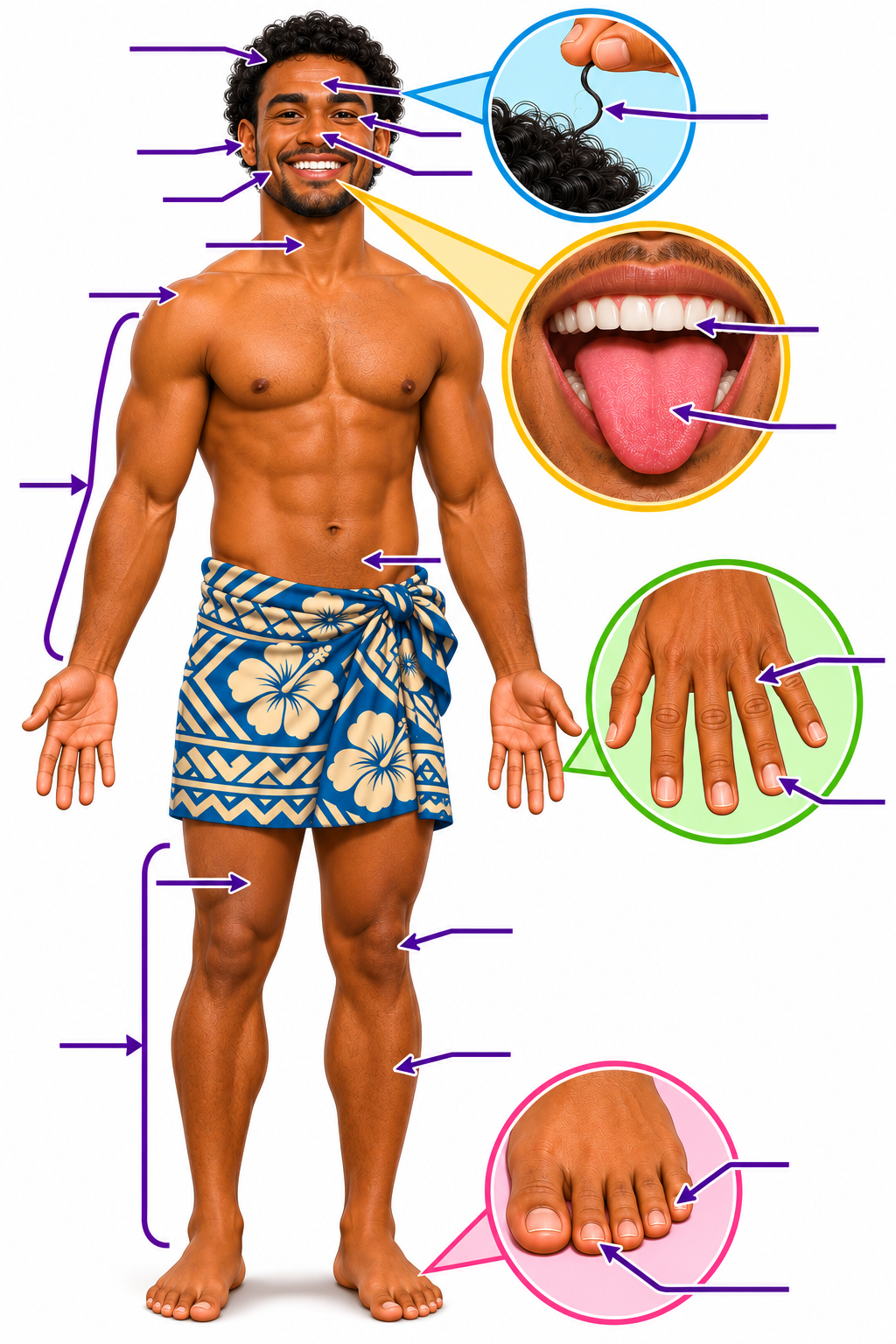
The ring is a visual guide. For small parts such as teeth, lips, fingers, and nails, use the original video or your own body to check the precise location.
Body word collection
The video is an optional reference. Its Fijian labels are built into the image, so the Hide activity uses the clean body map.
02 · Recall
Try hiding the Fijian labels while you practise. When ready, start an independent 17-word check to open the possession lesson.
03 · Possession
Earn 16 correct body labels in a fresh check to open this theory and its activities.
Once you reach 90%, the theory opens. You can always return to revise your body words.
In Fijian, a body-part word can take a possessive ending. We will look at the relationship first, then choose a form. These examples follow Vosa Vakaviti Raraba and still need qualified speaker review before public teaching.
Taukeni kuri: a checked example for “my teeth.” Compare na noqu vale (“my house”): noqu is before vale. It is not the default before every body word.
One, two, a few, or many changes the ending. “A few” does not have to mean exactly three.
Inclusive means the speaker and listener are together. Exclusive means the listener is outside the speaker’s group.
Try the viewpoint switch
Choose a group to see its relationship and the corresponding attached ending.
Quick understanding check
Select one answer for each idea. Feedback explains the distinction before you move on.
Apply it
Look at the people first. Then choose the attached ending that expresses that relationship. These are ending choices; complete body-part words need their own checked examples.
The original video supplies the starting word list. Some labels can name more than one nearby part, and not every body word takes the same possession pattern. This preview keeps those differences visible while a qualified Fijian speaker reviews the final words and examples.